
Greasy Cook-Line Floors
Targeted degreasing breaks down oily residue around fryers, ranges, grills, and other accessible cooking zones. Floor material and soil severity determine the products and agitation method.
Serving Riverside, California & surrounding areas
Open 24/7
Kitchen Floor Cleaning · Riverside
Remove built-up grease, food residue, and embedded grout soil with a cleaning plan shaped around your kitchen, flooring, and operating schedule.
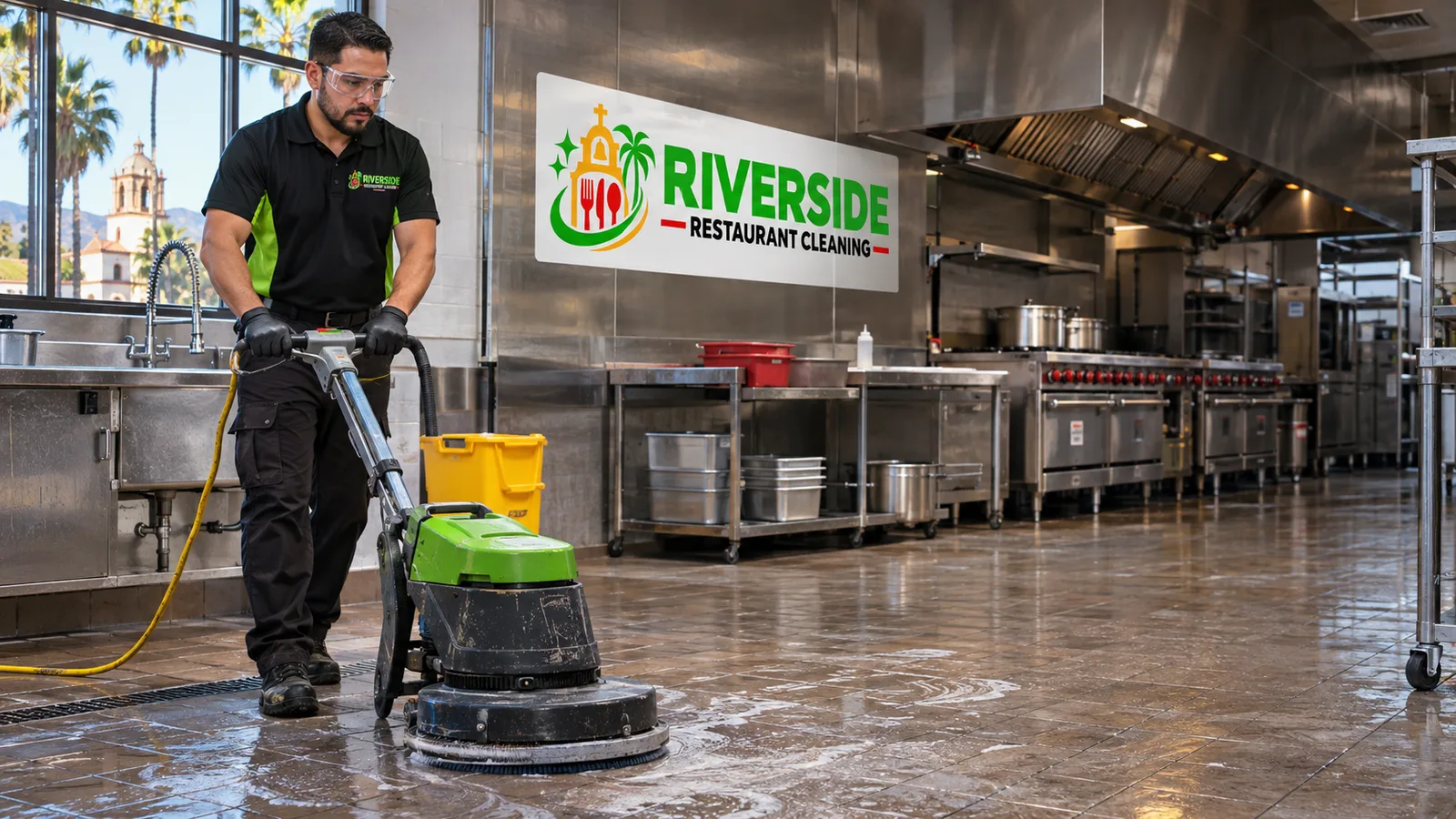
Commercial Kitchen Floor Cleaning targets the grease film, tracked-in soil, food residue, and darkened grout that routine mopping can leave behind. Riverside Restaurant Cleaning works on restaurant tile and other compatible hard flooring in cook lines, prep areas, dishwashing zones, walk-in approaches, and service corridors.
For every commercial kitchen floor cleaning, Riverside's restaurant specialists plan the work around the floor material, soil level, equipment layout, drains, and hours of operation. Before cleaning starts, we identify high-risk grease zones and discuss access, drying time, and any areas that must remain available. This creates a practical scope rather than applying the same treatment throughout the kitchen.
Our location at 1660 W Linden St, Suite 4 places our team near Riverside's central commercial areas. Downtown restaurants may need work coordinated around evening dining and limited loading access. University Avenue businesses often contend with frequent foot traffic and fast table turnover. Magnolia Center includes established dining and retail properties where kitchen layouts and floor conditions vary widely.
Each setting calls for a schedule that respects deliveries, prep, and opening time.
Deep Floor Care
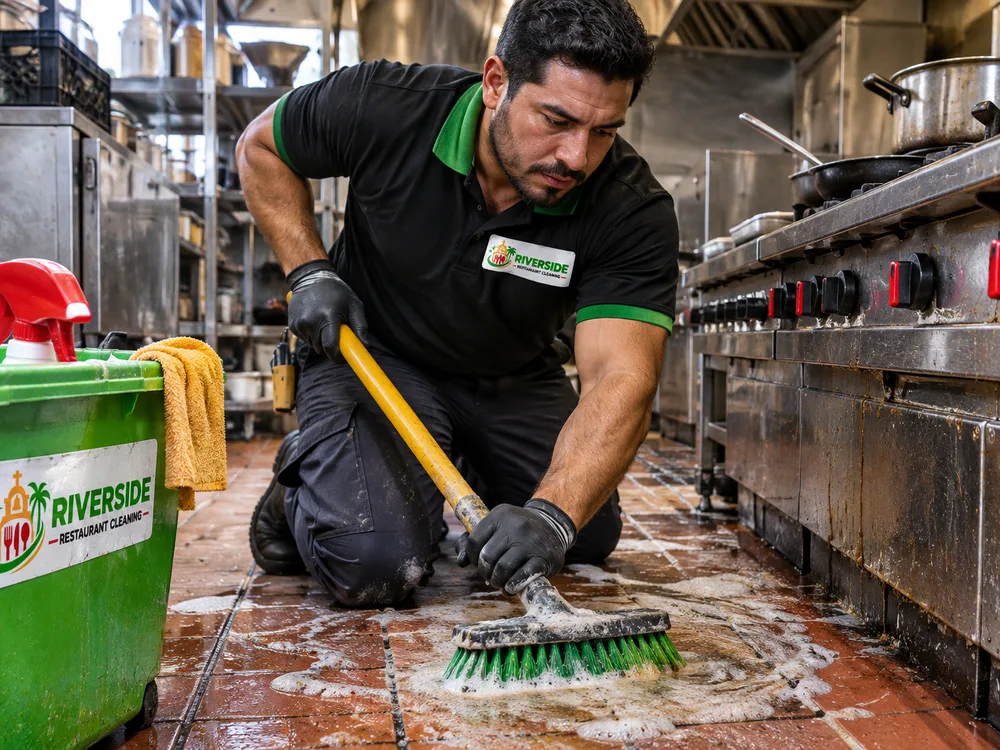
Grease spreads farther than the cook line. Shoes and cart wheels can carry it toward prep stations, dish areas, thresholds, and dry-storage approaches. Repeated mopping with dirty solution may redistribute that residue, while soil settles into textured tile and recessed grout joints.
Professional kitchen floor degreasing starts with the right chemistry and controlled dwell time. The cleaner needs time to break the bond between oily soil and the floor, but it must also be compatible with the tile, grout, and surrounding surfaces. Agitation then loosens embedded buildup. Commercial equipment lifts the suspended soil instead of moving it around, and a rinse removes remaining cleaner and residue.
Extra attention is given to edges, corners, grout lines, and accessible spaces near fixed equipment. The objective is a uniformly cleaned surface without leaving a slick chemical film. Heavy deposits may require repeated treatment, particularly where grease has accumulated over a long period.
Floor Cleaning Scope
Targeted degreasing breaks down oily residue around fryers, ranges, grills, and other accessible cooking zones. Floor material and soil severity determine the products and agitation method.
Textured quarry tile, ceramic tile, and compatible hard surfaces are cleaned with methods chosen for their finish and condition. A test area may be used when material compatibility is uncertain.
Grout lines collect grease, carbonized residue, and fine soil below the tile face. Focused agitation helps release buildup from sound grout without treating damaged joints as if they were intact.
These areas can hold food residue, soap film, and tracked grease. Cleaning is coordinated around movable items, drains, and the need to return the area to use.
Perimeters, transitions, and routes between the kitchen and dining room often show uneven buildup. Detail work helps prevent a clean center surrounded by dirty edges.
A repeat schedule can be based on cooking volume, floor texture, traffic, and how quickly grease returns. Frequency should reflect actual conditions rather than a generic calendar.
Six-Step Service Process
Step 1 of 6
We identify the flooring, grout condition, greasy zones, floor drains, access restrictions, and fixed equipment. Existing cracks, loose tiles, failed grout, or damaged transitions are documented because cleaning does not repair them.
Step 2 of 6
The plan defines which areas are included, what must be moved, and how the work fits around closing, prep, deliveries, and reopening. Operators should remove food, loose supplies, and small movable items before the appointment.
Step 3 of 6
A commercial cleaner suited to the surface and soil is applied in controlled sections. Adequate dwell time helps loosen greasy deposits without allowing the solution to dry on the floor.
Step 4 of 6
Mechanical or manual agitation works the solution into textured surfaces and grout joints. Corners, perimeters, and accessible equipment edges receive focused attention where larger machines cannot reach.
Step 5 of 6
Liquefied grease, soil, and spent solution are recovered rather than pushed toward another area. The floor is rinsed as needed so cleaner residue does not remain as a sticky or slippery film.
Step 6 of 6
We inspect the cleaned areas, point out staining or damage that cleaning cannot correct, and confirm drying conditions. Kitchen traffic should resume only when the surface is dry and the operator has checked it.
Material-Specific Care
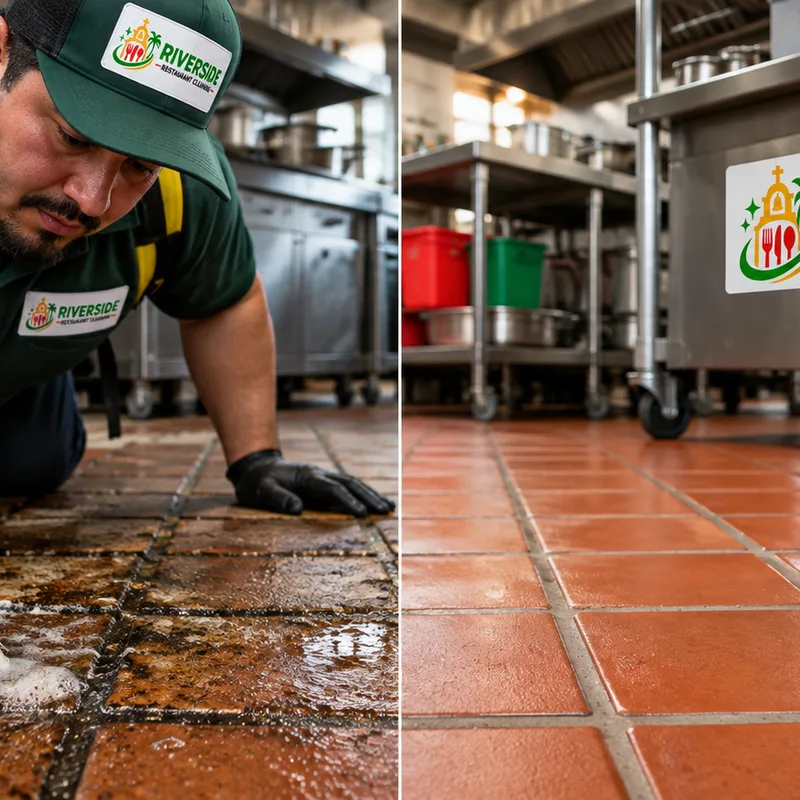
Quarry tile is common in commercial kitchens because its textured surface provides traction, but that texture also holds oily soil. Ceramic tile may have a smoother face while its grout remains porous. Concrete, resilient flooring, and specialty floor systems require different chemical and mechanical limits. Identifying the material comes before choosing pressure, brushes, pads, or degreaser strength.
Restaurant tile cleaning should separate removable soil from permanent change. Cleaning can remove grease and grime, but it cannot restore missing grout, repair cracked tile, correct low spots, or reverse discoloration absorbed into damaged materials. Strong acid is not a substitute for proper degreasing and may harm grout or nearby surfaces. Likewise, adding more chemical does not automatically improve the result.
Riverside's warm conditions can shorten solution dwell time and floor drying patterns, especially near open service doors or hot equipment. The floor is handled in manageable areas so the cleaning solution stays active long enough to work. Air movement and kitchen temperature are considered before the space returns to normal traffic.
Pricing Factors
Commercial kitchen floor cleaning in Riverside typically costs about $0.35 to $1.25 per square foot, while small or minimum-service visits may run about $250 to $500. Heavy grease, detailed grout work, difficult equipment access, after-hours scheduling, and repeated treatments can raise the total.
Final pricing depends on floor area, material, soil level, layout, movable equipment, water access, drains, and the requested frequency. A recurring restaurant floor cleaning plan may be priced differently from a one-time restorative visit. The exact cost is confirmed after the work area and condition are assessed.
A written scope helps your team plan around food removal, equipment access, cleaning time, and the point when the floor can return to service.
Call for a Free QuoteScope, Access, and Scheduling
Many restaurant kitchen floor cleaning visits can be completed within several hours, but the actual time depends on square footage, grease accumulation, grout condition, equipment access, and drying needs. A compact Downtown kitchen with tight fixed equipment may require more detail work per square foot than a larger open prep area. Timing is confirmed after the work area is reviewed.
After-hours scheduling may be available and is often the practical choice for an operating kitchen. The work window must allow time for preparation, cleaning, soil recovery, rinsing, inspection, and drying before employees return. Delivery schedules, early-morning prep, and shared access points should be discussed when setting the appointment.
Small movable items usually need to be removed, while large fixed equipment is cleaned around unless relocation is specifically included in the scope. Operators should clear food, mats, boxes, rolling racks, and loose supplies. Moving gas-connected, hardwired, or plumbed appliances requires qualified handling and is not assumed as part of floor cleaning.
Grout cleaning removes removable grease and embedded soil, but it cannot make damaged or permanently stained grout new. Missing joints, cracks, failed repairs, and deep discoloration may remain visible after cleaning. The initial inspection separates likely cleaning results from conditions that require grout repair or replacement.
Many quarry tile, ceramic tile, concrete, and compatible commercial floor systems can be cleaned, but the method depends on the material and finish. Unknown coatings, damaged floors, and specialty systems may require manufacturer guidance or a test area. Product compatibility is checked before broad application.
The right frequency is based on cooking volume, fryer use, foot traffic, floor texture, and how quickly oily residue returns. A high-output cook line may need more frequent degreasing than a low-grease prep operation. Daily sweeping and mopping remain necessary between professional visits, and the recurring interval can be adjusted after observing the floor over time.
Removing grease and cleaner residue can improve the cleanliness of the walking surface, but no cleaning service can guarantee that a floor will be slip-proof. Operators still need prompt spill response, suitable footwear, correct daily chemical use, maintained mats, adequate drainage, and repair of damaged or uneven flooring.
Remove exposed food, loose supplies, floor mats, boxes, and movable carts before the scheduled work window. Staff should identify sensitive equipment, restricted areas, alarm procedures, water access, and the required reopening time. Riverside locations with limited loading or shared rear access should also reserve a workable arrival and equipment route.
Define the Floor-Care Scope
Tell Riverside Restaurant Cleaning about your floor material, kitchen size, greasy problem areas, operating hours, and preferred service window. We will help define a practical scope for tile, grout, and floor degreasing.